Adolf Hitler, Biographical Time-Line, Part One
by Wally O'Lepp
Introduction
Investigating the story of Adolf Hitler is similar to exploring a fractal, as the further one travels into it, the more complex it becomes. One of the major difficulties in achieving an authentic level of understanding of the Hitler phenomenon is the abundance of spurious sources. The migraines of many a historian can be directly attributable to this reality. The myths abound: Hitler was Jewish with a Rothschild ancestor; Hitler had only one testicle; Hitler had two testicles, but one was bitten off by a goat; Hitler once lived in Liverpool, England; Hitler was insane; Hitler contracted syphilis from a French prostitute during WW1; Hitler took Golden Showers on alternate Thursdays; Hitler knew nothing about the Holocaust and would have disapproved had he known; Hitler's 'real' name was Schicklgruber; Scientists have cloned Hitler's lip, and it's growing a mustache; Hitler never wanted war but was forced into it by an 'International Jewish/Marxist/Capitalist Conspiracy'; Hitler was a homosexual; Hitler escaped his presumed death in the bunker and is at this very moment playing cards with Elvis and some mildly nervous Arab fellows; and so on. Most of us have heard at least a few of these, and possibly believed a few as well.
The ambiguous and sometimes contradictory evidence is ready made for those who would tell the story with their own agenda, German politicians and so-called 'Revisionist' historians being two of the most obvious examples. Objectivity, the ideal of the true historian, is harder to come by in the field of Hitler Studies than in nearly any other discipline that is not theologically based. In a field that touches on such charged issues and events as nationalism, racism, the events collectively referred to as the Holocaust, the very nature of war and peace and good and evil, emotions tend to cloud, or at least affect, the judgment of even the most disciplined scholar. This writer, while striving diligently to present an objective picture, claims no special immunity from the human frailty of being moved emotionally by that which touches one in ways both conscious and otherwise. Although I am without an agenda, I nonetheless have an opinion, but one that is based on literally decades of research, ploughing through what Ron Rosenbaum called a "terra incognita of ambiguity and incertitude where armies of scholars clash in evidentiary darkness over the spectral shadows of Hitler's past." Therefore, since a mere listing of only the pertinent facts would be pretty stale fare, I have taken the liberty to editorialize along the way. My hope is that the accumulated information from all available sources, presented in an in-depth timeline approach, will provide the reader with a sense of chronological clarity and be an aid to understanding this complex story.

 
--Wally O'Lepp
Part One
Antecedents and Infancy
"Today it seems to me providential that Fate should have chosen Braunau on the Inn as my birthplace. For this little town lies on the boundary between two German states which we of the younger generation at least have made it our life work to reunite by every means at our disposal."--Adolf Hitler from Mein Kampf

Adolph Hitler's home turf for most of his youth, however, was the Waldviertel ('the wooded quarter') region of Austria, between the Danube River and the frontiers of Bohemia and Moravia. Only 50 miles from the Austrian capital of Vienna, it was more than a few hundred years away; poor and stubbornly rural. As in any border region, invasions were a commonplace occurrence over the centuries: Napoleon's armies, Huns, Bohemians, Czechs, and even Swedes. All these invasions left their mark on the ethnic background of the inhabitants; in particular a Czech influence deriving from the Hussite Wars.
 
Hitler's ancestors, on both sides, had lived in this region as long as anyone could remember.
(Click for larger map)
May 11, 1435: Hannsen Hydler shells out 40 Viennese pounds for some property on the Thaya River, making him the earliest documented 'Hitler' in the region.
 
There are countless spelling variations of Hitler's family name. Most people in those days were illiterate, having no idea how to spell their own names. When the priests, some of whom seemed to have a talent for creative spelling, would record the marriage or baptism, they would write down whatever they thought it sounded like when the person uttered it. This would vary as dialects, as well as the teeth of the speakers, evolved.
 
1475: Hans Hytler pays his taxes.
 
From this point on, the historical record contains many Heitlers and Huedlers and Hiedlers and Huetlers and Hytlers and Hittlers, until, in 1702, the first fully fledged Hitler marries someone or pays something and has his name recorded. Although it was once suspected that the name was of Czech derivation, it is probably not, and Hitler would no doubt turn over in the grave he doesn't have, if the name were found to be so. The best guess is that the surname Hitler is derived from an old 15th century Walderviertelian dialect, meaning 'small cottager' or 'smallholder'
 
1672: Stephan Heidler, the most distant direct ancestor of Adolf Hitler documented, is born in Walterschlag.
 
April, 1795: Maria Anna Schicklgruber, Adolf Hitler's paternal grandmother, is born in the hamlet of Strones.
 
January 19, 1830: Johanna Huettler, Adolf Hitler's maternal grandmother, is brought into the world by the wife of farmer Johann Nepomuk Huettler, Eva Maria.
 
Pater Semper Incertus Est
 
June 7, 1837: The unmarried, 42 year old Maria Anna Schicklgruber of the village of Strones, a 'hotel servant' in the Wooded Quarter, gives birth to Adolf Hitler's father, Alois. The space for 'Father' on the birth form is left blank. He will be known as Alois Schicklgruber for the next 40 years.
 
1842: The older brother of Johann Nepomuk Huettler, Johann Georg Hiedler, a 50 year old 'wandering miller' originally from Spital and variously described as 'shiftless' and 'no good lazy,' marries the much older (but quite prosperous and in attractively poor health) Maria Anna Schicklgruber. Apparently, the couple never actually live together. For reasons never made clear, Georg does not follow usual custom and legitimize her child, Alois, then 5 years old.
1847: Maria Ann (Schicklgruber) Hiedler dies of a stroke. Her husband, Johann Georg Hiedler, is nowhere to be found, but Georg's 40 year old brother, Johann Nepomuk Huettler, had already taken young Alois Schicklgruber into his family's medium sized farm in Spital shortly after Maria Ann and Georg were married. He will raise him with his three daughters, one of whom, Johanna Huettler, will become the mother of Alois's third wife, Klara Plozl.
 
Late 1850: The fourteen year old Alois Schicklgruber leaves Nepomuk's farm to seek his fortune in the big city. He will be apprenticed to a cobbler in Vienna until his eighteenth year.
 
Alois is the only one of Hitler's ancestors, on either side, to ever advance his social position beyond that of peasant. Critics, such as the noted historian Helmut Heiber, have pointed out, with delicious irony considering Hitler's eugenic beliefs, that the 'aberrational quality of the Hitler family, beginning with the ambitious and enterprising father of Adolf, shows that other blood must have entered the Lower Waldviertel stock, which had been weakened by years of inbreeding.'
 
1855: Alois Schicklgruber tires of shoemaking and becomes a low grade employee of the Austrian Ministry of Finance; a Border Guard.
 
1857: Johann Georg Hiedler dies of a stroke.
August 12, 1860: Klara Plozl, Adolf Hitler's mother, is born of a union between Hitler's maternal grandmother, Johanna Huettler, and the farmer Johann Polzl, just thirty miles north of the blue Danube in the small village of Spital.
 
June 7, 1861: The upwardly mobile Alois Schicklgruber becomes a Revenue Clerk.
 
1864: Alois Schicklgruber is promoted to supervisory status.
 
1871: Alois Schicklgruber is again promoted, this time to Assistant Inspector of Customs.
1875: Alois Schicklgruber becomes a civil servant of some distinction, a Senior Assistant Customs Officer. He also marries for the first time, to Anna Glasl-Hoerer; the well-to-do but sickly daughter of a tobacco speculator and fourteen years Alois's senior. The couple will have no children.
June 6, 1876: A legal notary in Weitra takes the testimony of three illiterate witnesses: 'The undersigned witnesses hereby confirm that Georg Hiedler, who was well know to them, acknowledged paternity of the child Alois, son of Anna
Schicklgruber, and they request that his name be entered in the baptismal record.'

XXX Josef Romeder, Witness 
XXX Johann Breitender, Witness 
XXX Englebert Paukh, Witness.
Why, after being apparently contented with the Schicklgruber handle for 40 years, did Alois decide to change his name? August Kubizek, a mostly reliable primary source for Hitler's Vienna years, speculated that since old Nepomuk had no male heirs, he wanted Alois to assume the family name to continue the line, and that Nepomuk made out a will leaving part of his estate to Alois if he took the name. Kubizek should have stuck with what he knew: a will to this effect has never been found; and Alois, with a 50 year old wife at the time, was not likely to sire any immediate heirs. Alois, who was of course literate, chose the spelling Hitler, not Huettler, as Nepomuk preferred. Furthermore, the fact that Nepomuk himself did not bear witness at Weitra does nothing to bolster the contention that he desired the change for whatever reason. One has to think that Nepomuk's testimony, being the brother of Georg, would have carried more weight than that of the three witnesses, only one of which was a family member: Josef Romeder, who was married to Nepomuk's daughter, Walburga.
June 7, 1876: The parish priest of the now verfallen Doellersheim hamlet strikes out the name Schicklgruber from the birth registry, inserts the phrase 'within wedlock' to replace 'out of wedlock', and fills in the space for 'Father', until then empty, with 'Johann Georg Hitler.' The end result of all this shady chicanery (even if Georg really was Alois's father, the 'within wedlock' line is obvious Bavarian bologna) is that Alois Schicklgruber now legally assumes the name Alois Hitler.
 
What's in a name? Adolf Hitler would describe this name change as the best thing his old man ever did. He once opined to Kubizek that Schicklgruber was "...so uncouth, so boorish, apart from being so clumsy and unpractical... (Adolf) found 'Hiedler'...too soft; but 'Hitler' sounded nice and was easy to remember." It's been said so often that it has become a cliche, but it is obvious that the faintly comical 'Heil Schicklgruber' would certainly not have had much appeal to the masses.
 
Was Johann Georg Hiedler really Adolf Hitler's grandfather, as Hitler himself believed? That Georg never acknowledged the fact is problematic. The strongest second choice would be Georg's brother, Nepomuk, the man who so readily took in the young Alois. Proof of paternity is lacking in each case, however. We will probably never know. One thing is clear, however: that with the ambiguity in Hitler's family tree concerning the identity of his paternal grandfather, Adolf would not have been eligible to marry an 'Aryan' maiden under his own eugenics laws.
 
Jan 6, 1877: Alois Schicklgruber's name officially and legally becomes Alois Hitler.
 
1880: Alois's wife, Anna (Glasl-Hoerer) Schicklgruber, having had enough of Alois's continuing indiscretions, sues for a legal separation.
Jan 13, 1882: Alois Hitler's mistress, Franziska 'Fanni' Matzelberger, gives birth to Adolf Hitler's half-brother, Alois Jr.
 
April 1883: Alois Hitler's first wife, Anna Glasl-Hoerer, dies of consumption.
 
May 22, 1883: Alois and Franziska are legally married. Though quickly legitimized after the marriage, Alois JR nonetheless follows in his father's footsteps with an initially unenviable surname. Soon after, Adolf Hitler's half-sister, Angela, is born.
 
Early 1884: Franziska Hitler develops tuberculosis and is sent away for treatment as Alois's 20 year old niece, Klara Plozl, moves in to help around the house.
 
August 10, 1884: Franziska Hitler dies. Klara Plozl, already pregnant with the first of the 6 children she will bear for the man she continues to call 'Uncle,' becomes Alois's mistress.
January 7, 1885: Alois Hitler legally weds Klara Polzl. "We were married at six o'clock in the morning, and my husband was already at work by seven." That evening there was a wedding reception at the Gasthof zum Pommer, where the Hitlers were living, but the couple have no honeymoon.
 
May 17, 1885: Klara Hitler gives birth to a boy, Gustav.
 
September, 1886: Klara Hitler gives birth to a girl, Ida.
 
1887: Klara again gives birth to a boy, Otto, who dies within a few days.
 
December 10, 1887: Two and a half year old Gustav Hitler dies of diphtheria.
January 2, 1888: Little 15 month old Ida Hitler also dies of diphtheria, leaving Klara, recently a mother of three, childless with two step-children to care for.
April 20, 1889: Adolf Hitler arrives into the world he is destined to alter so drastically. He is born between 6:00 and 6:30 PM, on the third floor of the Gasthof zum Pommer. It was probably helpful to his survival that Klara had been given a few years break since her last child. A Franziska Pointecker is the midwife.
 
April 22, 1889: Father Ignaz Probst baptizes little Adolf, writing his name as 'Adolfus' on the certificate.
 
Johanna Plozl, Klara's younger, hunchbacked sister, is named as one of the godparents. Although described as 'bad-tempered' and 'feeble-minded,' she was nevertheless extremely fond of her little godchild. 'Haniaunt', as she was called, would live in the Hitler home for Adolf's entire childhood. Johanna was the second of her generation in the Plozl family to have this genetically transmitted deformity. Hitler never had children, remarking that he was fearful that his offspring might be feeble-minded, as often happened to 'great men' in history; he would then name examples. This relative was perhaps the basis of that fear.
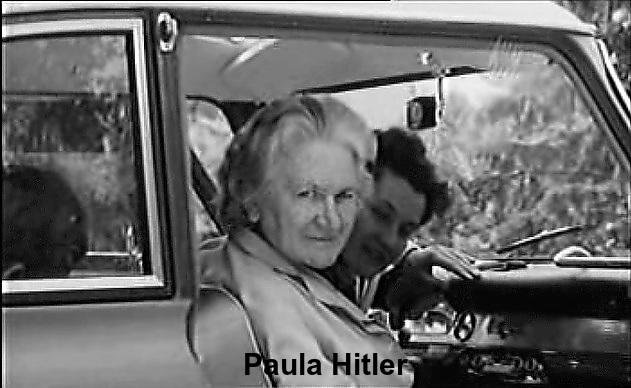
Klara Hitler was universally described as quiet, loving, and an excellent housewife and mother. A neighbor girl who passed the Hitler house daily remarked that Klara would walk little Paula 'to the fence door and give her a kiss; I noticed that because that was not what typically happened to us farm girls, but I liked it a lot. I almost envied Paula a little.'
 
Klara was described by the family doctor as a very gentle woman who never raised her voice. At five feet seven inches tall, she was nearly as tall as Alois, with 'very thick' dark brown hair and large, strikingly sensitive blue eyes. She was the only member of Hitler's family to go to Mass every Sunday. One of the many reasons Hitler would give in later years for not taking more stringent measures against the church was that he could never forget the 'solace' that Catholicism had given his mother. Hitler himself would never leave the church, though his opinion of it later in life was less than approving.
 
Adolf was the fourth child of Klara Hitler, but the first of only two to live to adulthood. Klara's first three losses made her extremely anxious about the frail and small child. It was more than just sibling rivalry that caused Alois JR to remark, "He was spoiled from early morning until late at night, and the stepchildren had to listen to endless stories about how wonderful Adolf was." By all accounts, though she was kind, loving, and indulgent to all the children in her care, Adolf was her special child. He could do no wrong in her eyes.
 
Psychologists/historians are wont to point out that Klara Hitler, by praising, rewarding, and protecting the lad, whether he was good or bad, failed to teach him the difference between the two. Perhaps. While in no way denying the sensible principle of teaching a child values through punishment as well as reward, there is also something to be said for the security of unconditional love, unconditionally expressed. It is little wonder that Hitler would grow up to worship his mother as the finest woman he'd ever known, keeping her picture always at his bedside.
Alois, on the other hand, showed little favoritism; he was domineering and demanding to everyone in the household without exception. As is usual with self-made men, he worshiped his creator. He had made his way in the world through the civil-service, and naturally assumed that his sons would follow suit. When a cousin of Alois asked him his advice on a civil service career for the cousin's own son, the by then Assistant Higher Customs inspector gave this revealing reply: "Don't let him think that Finanzwach is a kind of game, because he will be quickly disillusioned. First, he has to show absolute obedience to his superiors at all levels. Second, there is a good deal to learn in this occupation, all the more so if he has little previous education. Topers, debtors, card players, and others who lead immoral lives cannot last. Finally, one has to go out on duty in all weathers, day or night." One can only assume that Alois is referring to public immorality, such as corruption, not the private variety. To be fair, illegitimacy and 'common-law' relations bordering on bigamy were not at all unusual in the time and place in question. This fact alone does not, however, make the behavior moral, or in any way alleviate the consequences of convoluted family structures on the affected children.
 
"Old Alois demanded absolute obedience. Frequently he put two fingers in his mouth, let out a piercing whistle; and Adolf, no matter where he may have been, would quickly rush to his father...He often berated him, and Adolf suffered greatly from his father's harshness."-Testimony of a neighbor of the Hitler's.
 
Psychologists/historians are wont to point out that Alois Hitler, by beating, berating, and belittling the lad whether he was good or bad, failed to teach him the difference between the two. Perhaps. While in no way denying the sensible principle of not indiscriminately beating your kid, I think it is fair to say that the 'Hitler was an abused child' theory of Hitler explanation only goes so far. Alois was not unlike many fathers, then and now, most of whose sons did not grow up to become vilified by the world as the epitome of evil.
1892: Alois is again promoted, to Higher Customs Officer of Passau, on the German side of the border. Thus, at the age of three, Adolf Hitler will finally live, for a time, in the country he will one day master. It is here, in Passau, that Hitler will acquire his distinctive Bavarian accent.
 
"The German of my youth was the dialect of Lower Bavaria; I could neither forget it nor learn the Viennese jargon."-Adolf Hitler
 
March 23, 1893: Klara again gives birth to a son, Edmund, her fifth child.
March 30, 1893: Alois Hitler is again promoted, this time to an office in Linz, the provincial capital. Since Edmund is so young and Klara still weak from giving birth, Alois goes to Linz by himself, leaving his family in Passau for what turns out to be another year.
 
End of Part One.
 
Copyright © 2003-2007 Wally O'Lepp All rights reserved.
Edited by Levi Bookin (Copy editor)
levi.bookin@gmail.com
Part Two: Adolf Hitler goes to school.
Subscribe to Hitler_Studies
Powered by groups.yahoo.com

FAIR USE NOTICE: This site may contain copyrighted material the use of which has not always been specifically authorized by the copyright owner. We are making such material available in our efforts to advance understanding of historical, political, human rights, economic, democracy, scientific, environmental, comic icons, wartime propaganda, and social justice issues, etc. We believe this constitutes a 'fair use' of any such copyrighted material as provided for in section 107 of the US Copyright Law. In accordance with Title 17 U.S.C. Section 107, the material on this site is distributed without profit to those who have expressed a prior interest in receiving the included information for research and educational purposes. If you wish to use copyrighted material from this site for purposes of your own that go beyond 'fair use', you must obtain permission from the copyright owner.